Range Repair
Level First, Parts Second: How Denver's Swelling Claystone Turns Into an 'Uneven Baking' Viking Oven Call
Uneven baking in a Denver kitchen is often a level problem rather than a thermostat: swelling claystone racks floors and cabinet runs and tilts the oven cavity. The first two minutes of the call should be a spirit level and a look at the reveal gaps.
Written by
Clifford Nakamura
Service technician — controls and intermittent faults · 22 years in the trade
- Viking appliances
- intermittent electrical faults
- connector and harness repair
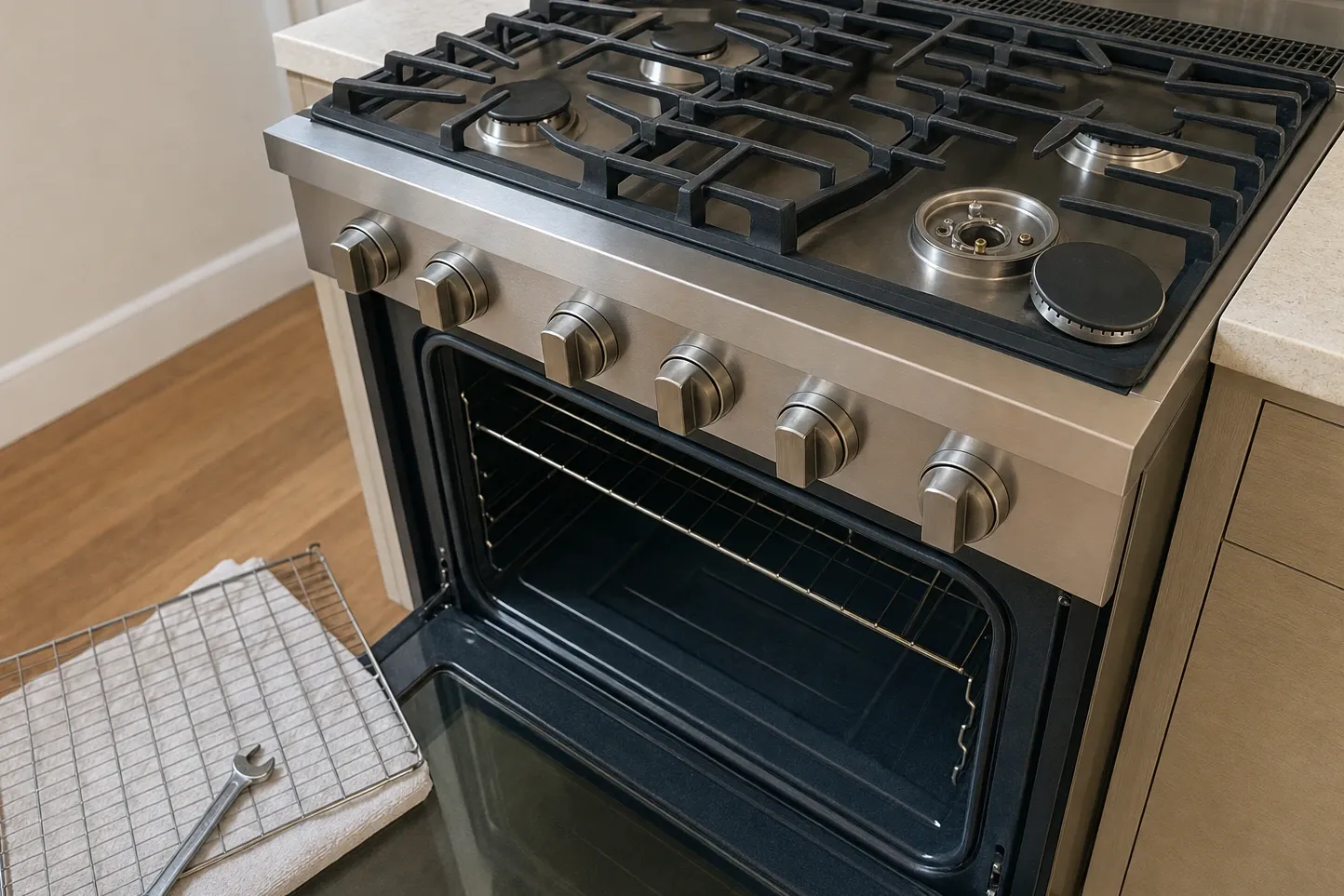
The ground under this city moves, and the appliance that reports it first is usually the range. Denver sits on swelling claystone, and a floor that has heaved a fraction of an inch under one corner of a kitchen produces a Viking that bakes crooked and reads, to everyone in the room, like a failed thermostat.
What people here assume is wrong with it
The assumption is almost always electronic. Cakes rise high at the back left, a roast browns on one side, the oven seems to lag its setpoint — so the suspect list starts at the thermostat, moves to the sensor, and ends at the convection motor or the control board. Parts get ordered before a level has come out of the bag.
The second assumption is that the door seal has gone, because the door has stopped pulling itself shut on its springs and the gasket looks like the obvious culprit. Both readings are reasonable. Both skip the cheapest test on the call.
What is actually happening
Ground movement does not break a range. It un-levels one, and an un-level range behaves like a broken one. The Colorado Geological Survey documents the metro’s expansive units — the Denver Formation and the bentonite-rich Pierre Shale — as soils that swell when wetted and shrink when dried, cracking foundations, slabs, sidewalks and streets across the Front Range. Its publication EG-01 covers the foundation consequences directly, and a case study in Clays and Clay Minerals, volume 44, records severe differential foundation movement in a southwest-metro subdivision built on steeply dipping Pierre Shale.
Seasonal heave and settlement rack a floor and a cabinet run out of level and out of square. A slide-in or freestanding Viking then sits with the oven cavity tilted. Heat stratifies unevenly front-to-back, so the bake is genuinely uneven and no calibration will square it. The door stops closing itself against its own springs and the gasket seals on part of its perimeter only, so the cavity leaks heat at one corner. On a built-in wall oven, the same racking pinches the cabinet opening and the door starts to bind or catch.
This is not an old-house problem or a new-house problem. University Hills, built from 1951 onward on postwar slab-and-crawl lots, sits squarely in this setting; so do the 1890s-to-1930s brick bungalows and Denver Squares of Platt Park, the 1920s Tudors of Park Hill, and the pre-war buildings around Cheesman Park where a professional range has been fitted into a compact original kitchen.
The evidence, in the order we look at it
The first two minutes of any uneven-baking call in this city should be a spirit level, not a multimeter. Level across the oven rack side to side. Level front to back. Then level the rack itself independently of the cabinet, because a bent or badly seated rack imitates the same fault for a fraction of the price.
Next, read the reveals. Look at the gap between the range and the countertop or cabinet on both sides and note whether it tapers. Check the door against its frame at all four corners. On a wall oven, look at whether the cabinet opening is still square by measuring both diagonals. A cabinet run that has racked will show it in those gaps before it shows anywhere else.
Then, and only then, test the appliance itself: a temperature probe placed at the centre of the cavity and read through a full cycle, the door seal checked around its whole perimeter, the convection motor and the sensor tested for what they actually are. If the cavity is level and the reveals are square and the bake is still crooked, now the parts conversation is an honest one.
The fix that holds
Level the appliance, then re-check the bake. On most slide-in and freestanding ranges that is the levelling legs and, where the floor has moved rather than the appliance, shims worked under the feet with the anti-tip bracket reseated afterwards — the bracket must engage properly once the height has changed, and it is routinely left behind after a levelling. Re-hang or adjust the door and re-seat the gasket after the cabinet is level, never before, because a gasket fitted to a tilted cavity will wear into the same one-sided pattern.
Where the floor is genuinely moving, say so plainly. Appliance levelling is a correction, not a cure for a structural problem, and a house that racks a cabinet run once will do it again. In that situation the honest advice includes re-checking the level annually rather than pretending a shim is permanent, and it may include a conversation with someone who works on foundations rather than ovens.
Where to stop and call
Stop if the door will not close square after levelling, if the cavity holds level and the temperature still drifts across a cycle, or if the bake is uneven on a wall oven whose cabinet diagonals no longer match. Those are the cases where the appliance and the building are both in the picture and the sequence of work matters.
A diagnostic visit is $89 and starts with the level. If the fault turns out to be a part after all: an igniter or burner assembly runs $190 to $420, an oven thermostat or heating element $210 to $480, a control board or touch panel $480 to $620, a refrigeration fan or defrost system $280 to $690, a dishwasher pump or control $200 to $410, and compressor or sealed-system work $1,370 to $3,400. Book on (720) 903-2603 or through the link on this page.
Follow-up questions
How do I check whether my range is level without tools?
Set a glass baking dish on the centre rack and half fill it with water; the waterline against the rim reveals a tilt the eye misses. Do it front to back as well as side to side. It is no substitute for a spirit level laid across the cavity, but it tells you in a minute whether the level is worth investigating.
My Park Hill kitchen floor slopes. Will levelling the range fix the baking?
Usually yes, as far as the appliance is concerned. Bringing the cavity back to level restores even heat distribution and lets the door seal along its whole perimeter again. What it cannot do is stop the ground moving, so in this soil the level is worth re-checking annually rather than being treated as a permanent correction.
My wall oven door has started to catch. Is that the hinges?
It can be, but check the cabinet first by measuring both diagonals of the opening. If they no longer match, the cabinetry has racked and is pinching the door, and fresh hinges will bind the same way within months. Where the opening measures square and the door still catches, the hinges or the door itself are genuinely at fault.